
What My Grandmothers Taught Me About Softness
Written by Jayona Monique Dorsey
Writer, Creative Strategist, and Cultural Storyteller.
Hampton University, Class of 2027
Strategic Communications major, concentrating in Public Relations with a minor in Marketing.
Long before "soft life" became an internet aesthetic, Black women practiced tenderness in everyday ways. It wasn't curated for Instagram or explained through morning routine videos. It lived in caregiving, rituals, faith, fashion, cooking, rest, and showing up for the people they loved.
Today, people often describe me as someone who lives a "soft life." They see my pink hair, the fresh flowers on my dining room table, the journals, the books and magazines scattered around my apartment, the slow mornings, the candles burning in the evenings, and the routines I've built for myself.
But softness was never something I discovered online.
It wasn't a trend I adopted.
It was my inheritance.
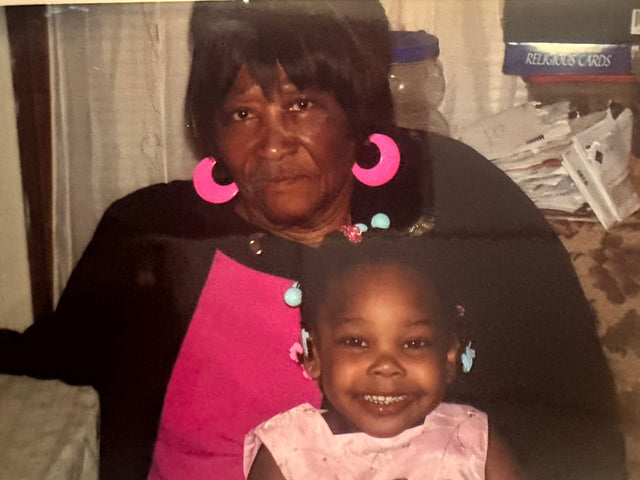
I was blessed enough to know both of my grandmothers, both of my great-grandmothers, and even my great-great-grandmother. My mother's mother, Sharnece, and her mother, Brenda. My father's mother, Cynthia, and my great-grandmother, Lillian. What I love most is that these women knew one another. They favored one another. They celebrated one another. They existed as one village that surrounded me long before I knew I would someday write about them.
I often say my grandmothers raised me.
In many ways, they did.
I grew up an only child to a young Black mother who was in college while working multiple jobs. She worked early mornings, late nights, and everything in between so I would never have to hear the word "no." While she was building a life for us, my grandmothers became the people who filled in the hours between.
At the time, those moments felt ordinary.
Looking back, I realize they were moments of inheritance.
No one ever sat me down to teach me what softness was. It was simply modeled for me, over and over again, until it became part of who I am.
Some inherit jewelry.
Some inherit recipes.
I inherited softness.
Every morning before elementary school, my mom would drop me off at my great-grandmother Lillian's house before the sun came up. She had to be at work nearly forty minutes away, so by 6:40 every morning I was sitting in my grandmother's dining room.

Breakfast was already waiting.
The television was already on.
If I hadn't fully woken up, she'd finish getting me dressed before school. Somehow, I was an eight year old drinking a hot cup of coffee while watching Little Einsteins, convinced that was completely normal.
Looking back, I smile because those mornings were never really about breakfast. They were about care.
She believed mornings should begin gently.
Whenever I stayed the night, I'd sleep beside her under the blast of the window air conditioner. Before bed she'd lather my skin with lotion and Vaseline until I practically glistened. Dinner was always homemade. As a picky eater, I protested plenty of Southern staples—pig's feet, black-eyed peas—but she fed me anyway because, to her, nourishment wasn't negotiable.
Whenever I got sick, she became even softer.
She'd wake up in the middle of the night to wipe my forehead with a cool damp towel, rub Vicks VapoRub across my chest and back, or sing to me until I stopped crying as a baby. I still remember getting food poisoning at her house in middle school. Burning with fever and barely able to stand, she managed to get me to her bright blue Chevy Cruze and used the OnStar system to find the nearest hospital because she still refused to trade in her flip phone.
She did all of this while living with a physical disability herself.
She never complained.
She simply cared.
From her, I inherited the belief that softness isn't weakness. Sometimes softness looks like endurance. Sometimes it looks like waking before everyone else so someone else's morning can begin peacefully. Sometimes it looks like faith that quietly carries a family through another day.
That was the first version of softness I ever knew.
As I got older, I learned that softness didn't always wear the same face.
My grandmother Cynthia couldn't have been more different.
She drove a big white Suburban, loved hats, very short hair, and was probably the biggest tomboy I knew. Yet she was also one of the gentlest women I've ever loved. She let me play behind the wheel of her parked truck before I was anywhere close to old enough to drive. She dressed me for church, let me play in her and my dads hats, and somehow made room for both toughness and tenderness in the same life.

She never missed my birthday parties.
She tried to climb into bounce houses.
She got face paint because I wanted face paint.
She showed up.
If my great-grandmother Lillian taught me softness through caregiving, my grandmother Cynthia taught me softness through presence.
She also taught me that femininity has never looked just one way.
She could present masculine, carry herself with strength, and still be the softest person in the room. She took me to volunteer to feed people experiencing homelessness, handing out food and water without expecting recognition. She was firm. She was direct. But everyone always said I brought out another side of her—a softer side.
Maybe because softness has always needed somewhere safe to land.
Then there is my grandmother Sharnece—better known as Niecy—whose version of softness is discipline.

She's been a nurse for longer than I've been alive, and somehow her life has always moved with a quiet rhythm. She wakes up around five every morning. Her scrubs are matching sets. Her pajamas are matching sets. Even her everyday clothes are coordinated two piece sets. Every drawer has its place, every sock still has its pair, and everything in her home moves with quiet intention.
The same gold jewelry she's collected since the '90s comes off every night and goes back on every morning. Saturday is bingo and subs or salads. Sunday is cleaning. Every two weeks it's her nails. Every four weeks it's her hair.
Routine isn't restrictive for her.
It's comforting.
In middle school, every morning on my drive to school, she'd already be on the phone with my mom during their commute to work. Before asking about anything else, she'd ask me how my morning was. Before every early cheer competition, she'd call to encourage me while we were still driving to the venue.
Consistency was her love language.
From her, I inherited the understanding that showing up for yourself is one of the softest things you can do.
Softness isn't always bubble baths and vacations.
Sometimes it's making your bed.
Answering the phone.
Keeping promises to yourself.
Building a life steady enough to hold you.
My great-grandmother Brenda, on the other hand, taught me that softness also requires honesty.

She lived in Pennsylvania for most of my life, so many of our memories were made over long phone calls instead of across the kitchen table. A lot of the photos we had together were ruined awhile ago in a basement flood, but the loss of those pictures has never felt like the loss of our relationship. She was hilarious without trying to be. She danced every chance she got, but would gasp dramatically every time a song had too many curse words. She spoke her mind because, as she'd often remind us, she'd lived long enough not to care what anybody thought.
She didn't tolerate foolishness.
She stood firmly in what she believed.
Yet one of the greatest lessons she gave me came much later.
As language changed and conversations around identity evolved, we'd gently explain why certain words were hurtful or outdated. At first, she'd laugh it off and insist she didn't care. But once she understood that our correction came from love rather than judgment, she listened.
She learned.
She adjusted.
Even in old age, she remained teachable.
From her, I inherited the courage to use my voice—and the humility to change when I know better. Looking back now, I realize none of these women taught me softness in the same way. One taught me care.
One taught me presence.
One taught me discipline.
One taught me conviction.
Different women.
Different expressions.
The same inheritance.
When people compliment the woman I'm becoming, they're often complimenting pieces of women they've never met.
When I organize community events, I'm carrying Cynthia's generosity.
When I make Easter goody bags for children, I'm honoring Sharnece, who has made me one every single Easter since I was born—not the little plastic ones from the grocery store, but baskets overflowing with intention and love.
When I wake up early to write or carefully prepare breakfast before a busy day, Lillian is there. When I speak up for what I believe or challenge conversations that matter, Brenda is there too. Inheritance doesn't only live in our DNA.
Sometimes it lives in our habits.
In our rituals.
In the prayers we repeat without realizing who first taught them to us.
In the way we care for ourselves because someone once cared for us first.
As Maya Angelou famously wrote, "I come as one, but I stand as ten thousand." I think about that line often because I've never felt like I walk through the world alone. I walk through it carrying generations of Black women whose love still shapes the way I move.
That is what I wish we talked about more when we talk about softness.
Softness didn't begin with an algorithm.
It didn't begin with expensive skincare, luxury vacations, or beige aesthetics.
Long before softness became content, it was culture.
It was inheritance.
Black women have always known how to make beauty out of survival, tenderness out of responsibility, and care out of very little. My grandmothers didn't call it a soft life.
They simply called it living.
And because of them, softness has never been something I perform. It is something I inherited.

0 Comentarios
No hay comentarios todavía. Sé el primero en comentar.