
Before There Was a Tradition, There Had to Be a First
Written by Jayona Monique Dorsey
Writer, Creative Strategist, and Cultural Storyteller.
Hampton University, Class of 2027
Strategic Communications major, concentrating in Public Relations with a minor in Marketing.
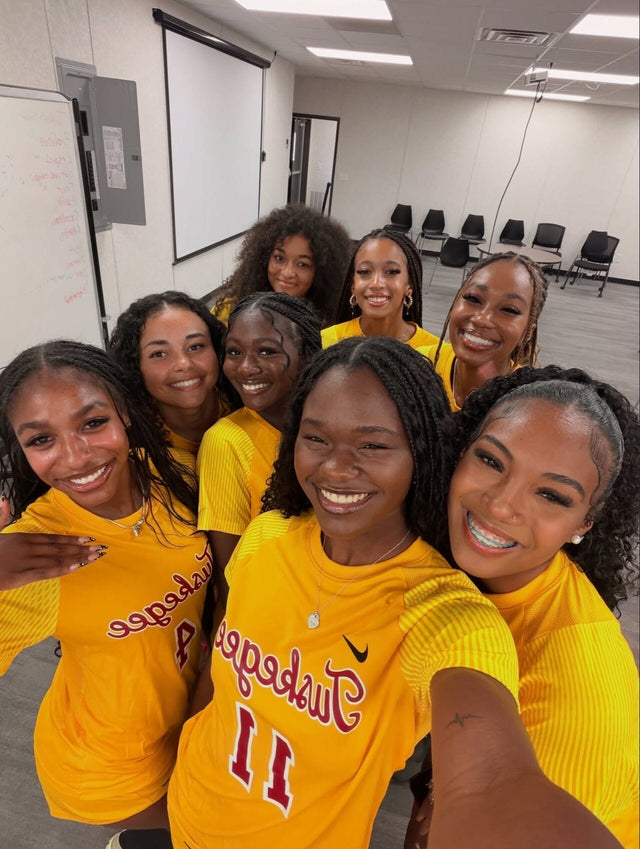
Before there could be a Tuskegee soccer tradition, there had to be women willing to become its beginning.
There were no records to break, no rivalry to inherit, no championship banners to chase. No older sister could tell them what the first season would feel like because, in Tuskegee women’s soccer, there was no “before.” There was only now.
When Tuskegee University debuted its inaugural men’s and women’s soccer programs, these athletes did more than put on a new jersey. They became the first names in a history that will eventually belong to generations of players. And perhaps that is the most beautiful part of being first: knowing that one day, you will be the story someone else tells about where it all began.

For Za’keya Charles, a junior liberal studies major and a captain of the inaugural team, being first means understanding that she is not only playing for the women beside her, but helping shape the experience of the women who will come after them.
“We are the captains of the first team,” she said. With younger players looking to them, she knows they are “setting the standard for every Tuskegee soccer player who comes after us.”
For Charles, leadership means understanding the weight of being someone else’s example, and helping create a culture worth inheriting.
That sense of sisterhood is woven throughout the inaugural team. Many of the players are freshmen, learning college soccer, adulthood and one another at the same time. There is no blueprint for becoming a team when the team itself is brand new. They are figuring it out together.
For freshman biology major and pre-dental student Mackenzie Allen, being part of that beginning has meant stepping into a spotlight alongside women who have become a community of their own.
“Seeing all the beautiful Black women around me” is what makes her most proud, Allen said.
After playing club and high school soccer as one of the only Black girls on her teams, she described the experience of being surrounded by Black women playing at a high level as something she had rarely experienced.
“Being able to not feel excluded and just, like, feel like everybody’s experiencing the same thing as me has been just really cool,” she said. “It’s a really beautiful thing to see for all of us to come together as a collective and just, you know, be able to feel safe with each other and just have like a family.”
For freshman sports management major Syrai Bryant, being part of that beginning has been “surreal.”
“I still wanted my first year to be just really good and one for the books because it was my first time,” she said. “I still have such high, big expectations for this first year and wanting it to really set the standard, as we always say, really set the legacy for the other girls that will be coming in after.”
Bryant already knows what it means to have a moment future players can point back to. During the team’s first inaugural game, she became the first woman in Tuskegee soccer history to score a goal.
Before college, she had avoided penalty kicks because of the nerves. But standing in that moment, she decided she could not become the same player she had been in high school.
“I came into speaking in college saying that I didn’t want to be the same person I was in high school,” Bryant said. “I genuinely felt the moment was created for me.”
Then she scored.
“My whole community showed up for me,” she said. “It was such a happy feeling.”
But the significance of Tuskegee soccer stretches beyond one goal. For Bryant, an HBCU offered something she had not realized she was missing: seeing Black women who look like her love the same sport.
“Being around so many Black women that love the sport as much as I do, it just brings another sense of growth,” she said. “It brings out a part of me that I never knew I had.”

That is part of what makes building a women’s soccer program at an HBCU so meaningful. Coach Stephens sees the opportunity as bigger than competition.
The goal is to “create more opportunities for Black women to compete at a high level while pursuing higher education—and to help them become the best versions of themselves both on the field and in the classroom.”
“Academics still come first,” he said.
For Stephens, who joined the program in March, coaching an inaugural team means “teaching as much as it means coaching—new habits, skills, terminology, discipline, organization and how to make good decisions at this level.” And because there is no established program to lean on, “everyone is learning together.”
“It’s exciting,” he said. “We’re trying to navigate it ourselves.”
Even the first goal became an emotional milestone. Not only for the players, but for everyone who helped build the program from nothing.
That is the complicated beauty of being first. You are responsible for the present while simultaneously building the future.
Stephens remembers the recruiting process as an exercise in believing in something that did not yet exist.
“It’s hard to see something that’s not here yet,” he said. The players, however, believed it could be possible. Now, he says, “the real work starts.”

And perhaps that work is ultimately what legacy asks of us.
Bryant does not define legacy by looking backward. She defines it by who gets to move forward because she was brave enough to begin.
“To say that I am building something that another girl with maybe the same story, the same journey, can look at and say, ‘I can do this too,’ is why I’m trying to build this legacy,” she said.
Stephens wants them to be fearless. To understand that “life, much like soccer, comes with losses, uncomfortable moments and the possibility of failure.” His hope is that the women “leave Tuskegee knowing how to take a loss and bounce back.”
And when future players eventually put on a Tuskegee soccer jersey, they will inherit more than a uniform. They will inherit the courage of the women who wore it before them.
“They have no choice but to give it their all because the players before them gave it their all,” Stephens said.
That is the weight of being first. But it is also the gift.
One day, there will be traditions. There will be rivalries, records and championships. There will be younger girls calling the inaugural players their first soccer sisters, studying their names and remembering the women who made it possible for them to arrive.
For now, these women are still learning how to become a team.
But someday, someone else will call what they are building tradition.
And before there was a tradition, there had to be a first.


0 Comments
There are no comments for this article. Be the first one to leave a message!