
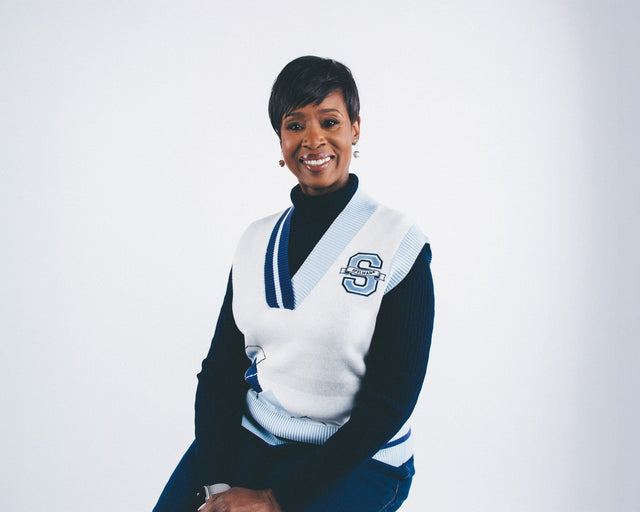
Sabrina Polote: The South Got Something To Say !
Written by Jayona Monique Dorsey
Writer, Creative Strategist, and Cultural Storyteller.
Hampton University, Class of 2027
Strategic Communications major, concentrating in Public Relations with a minor in Marketing.

What does it mean to become the woman other women can look toward? To build a life, grow into leadership, and still recognize the importance of reaching back for the women just beginning their journeys? For Sabrina Lynn Polote, the answer has a lot to do with remembering the women who poured into her.
A Savannah native, 1985 Spelman College graduate, and the 28th Regional Director of the Southern Region of Delta Sigma Theta Sorority, Incorporated, Polote has spent decades navigating leadership, service, and sisterhood. But beyond her professional accomplishments, her perspective comes from the experiences that shaped her as a Black woman and the people who continue to influence the way she moves through the world.
When asked to introduce herself beyond her titles and accomplishments, Polote reflects on the people and places that shaped her. Her connection to Savannah is deeply personal, and she carries that sense of home into every space she enters.
“It’s always important to me for me to represent them well,” she shared. “I better make sure I don’t embarrass the family, embarrass my hometown.”
That connection to home is part of her understanding of legacy. When she thinks about the women who helped shape her, she thinks about her mother, teachers, and and the women who poured into her along the way. Their influence did not end when she moved away or began building a career. She carries those lessons with her.
Her journey to Spelman College was another defining part of that foundation. As an only child, she knew her parents wanted her to experience college away from home. After visiting Spelman, she knew it was where she wanted to be.
“My Spelman experience was everything,” she said.


She remembers the immediate sisterhood, the experience of being surrounded by Black women, and professors who invested in their students beyond the classroom. She recalled Dr. Jack Stone staying late to help her with statistics, along with a business etiquette course that prepared students to navigate corporate America. From introductions and dining etiquette to professional dress, she learned how to enter new spaces without feeling she had to leave herself behind.
That experience helped shape how she understands Black womanhood, service, and leadership. It also gave her a community that continues to hold meaning decades later. In 2025, she celebrated her 40 year reunion.
After Spelman, Polote began a career at AT&T in 1990. Over more than 32 years, she moved from the call center into management and project management within finance. Her understanding of leadership was never limited to the title on her business card. When she managed a call center team, she made a point of taking calls alongside her employees.
“I appreciate what you do. I know what you do. Let me do it,” she recalled telling them.
She wanted her team to know that she understood their work and respected their contributions. That same approach has followed her into her current role.
Today, Polote leads the Southern Region of Delta Sigma Theta, the organization’s largest region, with more than 200 chapters and over 26,000 active members across Georgia, Florida, Alabama, Mississippi, Tennessee, and the Bahamas. Looking back on her journey she says, “it was not necessarily about setting out to reach one particular position.” People recognized her work and encouraged her to take on new responsibilities.
“I believe in honoring my commitments,” she explained.
For Polote, leadership requires continued learning, understanding the responsibilities attached to a role, and remaining connected to the purpose behind the work. It also requires knowing the people you serve. With a region of that size, she understands that leadership cannot simply happen from a distance. “It takes communication, organization, and the ability to recognize the individual women who make the larger community possible.”
That becomes especially important when talking about sisterhood. For Polote, mentorship means creating relationships where women feel supported, heard, and encouraged to grow. She believes that support starts with communication and being willing to learn from one another.
“We have to be able to communicate with each other,” she explained. “We have to understand that what may be normal for one generation may not be normal for another generation.”
She makes a point of bringing different generations into regional leadership, from collegiate members to women in their seventies. She understands that women can have different expectations and experiences depending on when and how they grew up.
She offered a simple example: an older member might become frustrated when a younger member does not know how to write a check, even though that younger woman may have grown up using digital payments. Instead of allowing those differences to create distance, she encourages women to understand one another.

As an experienced Black woman in leadership, her understanding of womanhood has also evolved. She says she has become more confident with age and more comfortable speaking directly while remaining professional and respectful. But one thing she wishes more Black women understood is that they do not need a formal title to recognize their power.
“Women are already leaders,” she said, pointing to the responsibilities women carry in their homes, families, careers, and communities. “We deserve credit, even if you have to give your own self the credit.”
That message connects directly to the responsibility she believes established Black women have to the generations coming behind them. It is not enough to occupy a leadership position. Women must also be intentional about making room for others.
“I think it’s important that we communicate with them. We praise them. We let them know that it’s okay to ask questions,” she said. “We have to listen to their ideas and implement them.”
For Polote, mentorship means more than offering advice. It means listening to what younger women are experiencing, understanding their needs, and making sure their voices can influence decisions. She recognizes that the world younger Black women are navigating may look different from the one older generations experienced. That is why she believes established women have to remain willing to learn, too.
This also shapes how she thinks about preserving the history of Delta Sigma Theta while encouraging younger members to find their own ways to contribute. Founded by 22 women at Howard University, the organization began with young women who had ideas and a vision for what they could build.
“I remind them that these were women their age,” she explained. “Your idea could be the next big thing. So let’s get it rolling and let’s see what we could do to make it happen.” It is a reminder that history is not something younger generations should only look back on.
“They are part of its continuation.” Honoring the women who came before means understanding the work they started and recognizing that the next chapter will require new voices, ideas, and perspectives.
When asked what lesson she would share with every Black woman, regardless of age or stage in life, Polote returned to the importance of knowing when to say no.
“You don’t have to say yes to everything,” she shared. She believes women should be honest about what they can commit to, respect their own limits, and make time for themselves. Even with the demands of regional leadership, she understands that rest and self care are necessary parts of being able to serve others.

And when it comes to the legacy she hopes to leave, her answer is grounded in something she learned at home: “You treat people the way you want to be treated.”
She wants to be remembered for consistency and respect, for treating people with the same courtesy regardless of their position. Her friends even call her “Diplomacy.”
To Polote, “being diplomatic does not mean avoiding difficult conversations. It means being honest while still respecting the person on the other side of the conversation.”

0 Comments
There are no comments for this article. Be the first one to leave a message!